Fallen Trees: Landowner Liability in High Winds (UK)
By Ansons Law
Published Updated 15 min read
In short
A tree's owner is liable only if it falls because of a danger they knew about, or should reasonably have spotted, and they did not take reasonable steps to deal with it. If a healthy tree comes down in a storm and nobody was at fault, you normally claim on your own home or comprehensive car insurance. A neighbour's fallen tree still belongs to them, so ask them to deal with it and agree who pays.
On this page
- Key takeaways
- If a neighbour's tree falls on my property, who is responsible?
- Who pays for the damage to my house or garden?
- Who is responsible for removing a fallen tree?
- Who is responsible if a tree falls on my car?
- If my tree falls on my neighbour's house, who is responsible?
- What should I do after a tree falls?
- When is a tree owner legally liable?
- Do I owe a duty to people on my land?
- What about trees next to roads and railways?
- My neighbour's tree looks dangerous. What can I do?
- Can I cut back my neighbour's tree?
- What if the tree is protected?
- How should tree owners look after their trees?
- How we can help
When a tree comes down in high winds, the first questions are usually who is responsible and who pays. The answer depends less on whose tree it was than on whether its owner knew, or should have known, that it was unsafe. This guide explains the law for homeowners whose house, garden or car has been damaged by a neighbour's tree, and for anyone with trees on their own land. It covers England, and we point out where the rules in Wales are different. The law in Scotland and Northern Ireland is different in places.
Key takeaways
- A tree's owner is not automatically liable when it falls. They, or their insurer, pay only if they knew, or ought reasonably to have known, that the tree was unsafe and did not take reasonable steps to deal with it, for example by ignoring a tree that was obviously dead, rotten or split, or had started to lean.
- If a healthy tree comes down in a storm and nobody was at fault, you normally claim on your own insurance.
- A neighbour's tree that falls onto your property still belongs to them. Ask them to deal with it and agree who pays, because the law on clearing up after a no-fault fall is not settled.
- If your tree falls on your neighbour's house, they normally claim on their own insurance. You are liable only if you were at fault, and your home insurance usually covers that.
- Comprehensive car insurance normally covers a tree falling on your car. Third party, fire and theft cover does not.
- Photograph everything before it is moved, tell your insurer straight away, and check whether the tree is protected before cutting more than is needed to make it safe.
- Tree owners should look over their trees regularly, especially after storms, and ask an arborist to check anything that worries them.
If a neighbour's tree falls on my property, who is responsible?
A tree belongs to whoever owns the land it grows from. Responsibility for it usually rests with whoever controls that land. That is normally the owner, but if the property is let or managed it can be the tenant, the landlord or a management company, depending on the tenancy agreement or lease. None of that makes them liable for every tree that falls.
There is no automatic liability for a falling tree. To recover your losses from your neighbour, you have to show they were at fault: that they knew, or ought reasonably to have known, that the tree was dangerous and did not take reasonable steps to deal with it.
The courts ask what a reasonable and prudent landowner would have done. A landowner is expected to know a little more about trees than most people, but not as much as a trained expert. An owner who knows too little to judge their own trees should ask someone who does. If the tree looked healthy and an ordinary check would not have revealed a problem, the owner is not liable, even if the tree comes down in a gale.
In a 2014 High Court case, part of a large ash in a garden in Staines fell onto a railway line on a windy December night. The cause was decay and a weak fork hidden under ivy, but the owner was not liable. She had looked over her trees regularly, there were no visible warning signs, and the law did not expect her to pay for expert inspections (Stagecoach South Western Trains Ltd v Hind [2014] EWHC 1891 (TCC)).
Who pays for the damage to my house or garden?
In most cases, your own insurer. If your neighbour was not at fault, you claim on your own buildings insurance, and contents insurance for anything inside, and you pay your own excess. Most home insurance covers storm damage and falling trees, but fences, gates and hedges are often excluded, and cover for plants and garden furniture is usually limited, so check your policy wording.
If your neighbour was at fault, you or your insurer can claim against them, and their home insurance usually includes liability cover for this. Your insurer may pay you first and then try to recover its costs, and your excess, from your neighbour or their insurer, but it does not have to. If any of your losses were not insured, you can claim them directly from a neighbour who was at fault.
Signs that a tree owner may have been at fault include a tree that was obviously dead, rotten or split, or had started to lean, warnings that were ignored, or a notice from the council about the tree.
Who is responsible for removing a fallen tree?
If the tree's owner was at fault, the cost of removing the tree can be claimed from them along with the cost of repairs. If nobody was at fault, the law does not clearly say who must pay to clear it. In practice neighbours usually agree what will happen, and the cost often falls on whichever insurer covers the damage. Even so, it is sensible to ask the owner in writing to deal with it. The law is not settled, but an owner who leaves their tree on your land after being asked, particularly if it goes on causing damage, risks a claim.
Home insurance usually pays to remove a fallen tree only where it has damaged your home or other insured property, and often only the part that caused the damage. Stumps, roots and the rest of a neighbour's tree are commonly excluded.
The timber still belongs to the tree's owner, and you can only deal with what is on your side of the boundary. Speak to your neighbour and agree, preferably in writing, who will deal with it before you cut it up or get rid of it. Before anything is moved, photograph the tree, the trunk or stump, the roots, the break and the damage. That evidence may decide whether a claim succeeds.
If a tree has fallen across a public road, the highway authority must clear it. That is usually the council, but National Highways looks after motorways and major A roads in England. The authority can recover its reasonable costs from the tree's owner, unless the owner proves they took reasonable care to stop the tree falling.
Who is responsible if a tree falls on my car?
Comprehensive motor insurance normally covers storm damage, including a falling tree or branch. Third party, fire and theft cover does not, and home insurance does not cover vehicles. A claim is often recorded as a fault claim even though you did nothing wrong, because your insurer cannot recover its costs from anyone. That can reduce your no-claims discount or raise your premium, unless your insurer recovers its costs from a tree owner who was at fault.
You can claim against the tree's owner, whether that is a neighbour, a business or the council, only if they were at fault. The leading case, Caminer v Northern and London Investment Trust Ltd [1951] AC 88, involved an elm that fell onto a passing car in London. The company that occupied the land was not liable, because the tree looked sound and there was no evidence that even an expert inspection would have revealed the danger.
If your car was damaged while you were visiting someone else's premises, such as a shop or pub car park, the occupier owes a duty to take reasonable care. That duty covers visitors' property as well as visitors themselves, but again there is no claim without fault.
If my tree falls on my neighbour's house, who is responsible?
Your neighbour will usually claim on their own buildings insurance. You are liable only if you knew, or ought reasonably to have known, that the tree was unsafe and did not take reasonable steps to deal with it. If you might be liable, tell your own home insurer straight away. Most home insurance includes cover for legal liability to other people, although some policies put it in the contents section rather than buildings, so check yours. Helping to make the site safe is fine, but do not admit liability or agree to pay without your insurer's written consent, because that can affect your cover.
If you rent your home, check your tenancy agreement and speak to your landlord. Responsibility for trees follows who controls them, which depends on what your tenancy agreement says.
What should I do after a tree falls?
- Keep everyone away. If power lines are down, treat them as live, keep well clear and call 105, or 999 if there is a danger to life.
- If the tree is blocking a road, report it to the council. Call 999 if it blocks a fast road or anyone is hurt or trapped. In Staffordshire, outside Stoke-on-Trent, report highways emergencies to Staffordshire County Council online or on 0300 111 8000. Stoke-on-Trent City Council runs its own highways service. If a tree is on a railway line, call Network Rail on 03457 11 41 41.
- Photograph the tree, the roots or stump, the break and all the damage before anything is moved.
- Tell your insurer as soon as you can, and tell your neighbour if their tree is involved.
- Check whether the tree is protected before cutting anything beyond what is urgently needed to make it safe.
- Keep receipts for emergency repairs and clearance.
- Take advice early if fault is disputed. Claims for damage to property must usually be started within six years, and claims for personal injury within three years.
When is a tree owner legally liable?
Owners are not insurers of nature, but they must act on dangers they can see, or that an ordinary person looking at the tree would notice. In practice:
- Ordinary homeowners should look over their trees informally and regularly, especially trees next to a road, a railway or a neighbour's home. They do not have to pay for routine expert inspections unless something prompts concern, or they cannot check the trees themselves, for example because they are away for long periods.
- Warning signs such as dead wood, fungus at the base, cracks or splits, hanging branches, a new lean or lifting roots should be checked by a qualified arborist.
- A storm is not an automatic excuse. In Witley Parish Council v Cavanagh [2018] EWCA Civ 2232, a large lime beside a main road fell after a stormy night. The parish council was liable because it had not inspected the tree often enough to find the decay that caused the fall.
- Failing to inspect is not enough on its own. The person claiming must also show that a reasonable inspection would probably have found the problem in time (Micklewright v Surrey County Council [2011] EWCA Civ 922).
- Councils and large landowners need a proper inspection system run by competent people. How often a tree should be checked depends on its size, age, condition and position.
Do I owe a duty to people on my land?
Yes, to visitors. Under the Occupiers' Liability Act 1957, the occupier must take reasonable care to see that people they invite or allow onto the land are reasonably safe, and that includes danger from trees and branches.
The duty to trespassers is much narrower. Under the Occupiers' Liability Act 1984, a duty arises only if the occupier knows, or has reasonable grounds to believe, that the danger exists and that someone may come near it, and the risk is one they could reasonably be expected to protect against. It covers injury, not damage to property, and a suitable warning may be enough.
People using a road or a public footpath are not visitors. If a tree falls on them from neighbouring land, their claim is in negligence or nuisance, under the same reasonable and prudent landowner test.
What about trees next to roads and railways?
Trees on private land beside a road are the landowner's responsibility, including inspecting them and cutting them back. Trees growing in the pavement or verge are normally the responsibility of the council as highway authority, which in most of Staffordshire is Staffordshire County Council.
Under section 154 of the Highways Act 1980, the council can serve a notice on the owner or occupier. It can require them to cut back a tree that overhangs a road or footpath and endangers or blocks people using it, or to cut back or fell a tree that is dead, diseased, damaged or insecurely rooted and likely to fall onto the road or footpath. The work must be done within 14 days of the notice. The owner can appeal to the magistrates' court, and if the notice is ignored the council can do the work itself and recover its costs.
Network Rail is responsible for trees inside the railway boundary. Trees on neighbouring land are the adjoining owner's responsibility, and the Staines case above shows how the courts approach them.
My neighbour's tree looks dangerous. What can I do?
- Tell your neighbour in writing, with photographs, and keep a copy. Once they have been warned, they will find it hard to argue later that they could not have known.
- If they do nothing, ask your local council for help. In most of Staffordshire that is the district or borough council, not the County Council, and in Wales it is the county or county borough council. If the council thinks the tree is likely to cause damage to people or property on your land, it can serve a notice under section 23 of the Local Government (Miscellaneous Provisions) Act 1976. The notice must give the owner at least 21 days to make the tree safe, and the council can do the work itself and recover its costs if the notice is ignored.
- If the tree threatens a road or footpath, report it to the highway authority.
Can I cut back my neighbour's tree?
You can cut back branches that overhang your land, and roots that grow into it, as far as the boundary. You do not need your neighbour's permission or have to give notice, although it is sensible and courteous to tell them first. However:
- You must work from your own side. Going onto your neighbour's land without consent is trespass.
- You can only cut back to the boundary. Cutting further, or harming the tree in other ways, can lead to a claim against you, and you may be liable if heavy cutting kills the tree or makes it unstable. Take an arborist's advice before cutting large branches or roots.
- The cuttings, and any fruit, still belong to the tree's owner. Offer them back. If your neighbour does not want them, dispose of them yourself rather than throwing them over the fence.
- You normally pay for the work yourself, unless the tree is causing actual damage that your neighbour knew or ought to have known about.
- Check first whether the tree is protected (see below). The protection applies to everyone, including neighbours cutting overhanging branches.
- It is an offence to intentionally damage or destroy a wild bird's nest while it is in use or being built, or to damage or destroy a bat roost, whatever the time of year.
Your neighbour is not generally responsible for leaves that fall naturally into your garden. A claim is realistic only where there is real damage, such as persistently blocked gutters or drains causing water damage, and your neighbour knew or ought to have known and did not act reasonably.
What if the tree is protected?
A tree may be protected by a Tree Preservation Order or because it stands in a conservation area. Your council can tell you, and many publish maps online. A protected tree remains the owner's responsibility; protection does not pass it to the council.
In England, you normally need the council's written consent to cut down, top, lop or uproot a tree with a Tree Preservation Order. In a conservation area, you must give the council six weeks' written notice before working on a tree that has no order, unless its trunk is no more than 75mm across, measured 1.5 metres above the ground. There are exceptions that matter after a storm:
- Dead trees can be cut down without consent, but you must give the council at least five working days' written notice first.
- Dead branches can be removed from a living tree without consent or notice.
- Urgent work needed to remove an immediate risk of serious harm, such as a split trunk leaning over a house, can be done straight away. You must do no more than is needed to make the tree safe, and give the council written notice as soon as practicable.
- A tree blown over or split by the wind is not necessarily dead. A partly uprooted tree may still be alive, and what is left standing, or the stump, may still be protected.
A tree that is only diseased or dying is not covered by these exceptions. If you rely on one, it is for you to show the work came within it, so photograph the tree before and after. If a protected tree is cut down or uprooted because it was dead or posed an immediate risk of serious harm, you will usually have to plant a replacement of a suitable size and species in the same place as soon as you reasonably can, unless the council agrees that you need not.
Cutting down or destroying a protected tree without the consent or notice the law requires is a criminal offence with an unlimited fine, and not knowing about the order is no defence. Other unauthorised work, such as lopping branches, can lead to a fine of up to £2,500.
In Wales, the law still allows work on protected trees that are dying, dead or have become dangerous, but you must be able to show the tree was in that state, and you will usually have to plant a replacement. The Welsh Government advises giving the council at least five days' notice first, except in an emergency. New Welsh planning law will change the rules but is not yet in force.
How should tree owners look after their trees?
- Look over your trees regularly and after every storm, especially any near a road, a footpath, a railway or a neighbour's home.
- Watch for dead wood, fungus, cracks or splits, hanging branches, a new lean and lifting soil or roots. A large mature tree can weigh many tonnes, and a single large branch can weigh close to a tonne.
- If something worries you, ask a qualified arborist to inspect the tree. The Arboricultural Association lists approved contractors for tree work and registered consultants for inspections and reports. Ask for proof of public liability insurance.
- Keep a record of your checks, with dates, photographs, reports and invoices. If anyone claims you were at fault, that record is your best defence.
- Make sure your home insurance includes cover for legal liability to other people.
How we can help
Ansons Law advises homeowners, landowners, farmers and businesses on liability for trees, claims for damage caused by fallen trees, disputes with neighbours and protected trees.
If you need advice about a fallen tree or the trees on your land, please fill out the contact form on this page, email Neil Faunch, Director and Joint Head of Commercial Property and Agricultural Law, at nfaunch@ansons.law, or call 01543 267191. If you are in dispute with a neighbour or want to bring a claim, our Dispute Resolution team can help.
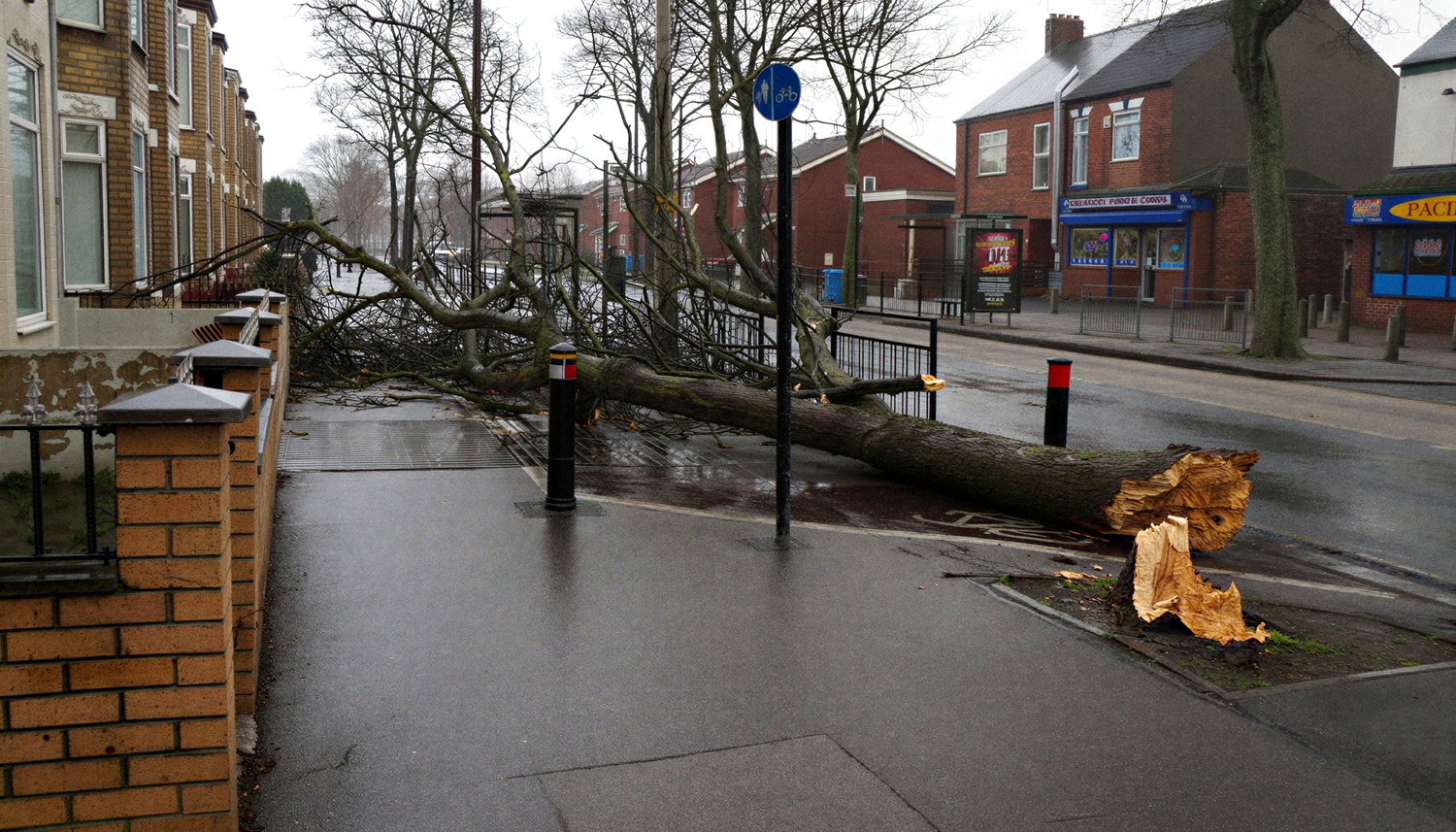
Photo: fallen tree on Southcoates Lane, Hull, by Ian S, licensed under CC BY-SA 2.0. Cropped, enlarged and colour-adjusted by Ansons Law; the edited image is shared under the same licence.
This article is general information about the law in England and Wales on the date it was published. It is not legal advice for your situation.